Events

Almost all our Event recordings can be found at our Youtube page!

2026–2027

8 events
Epoch 3: How Machines Learnt to Draw — event artwork

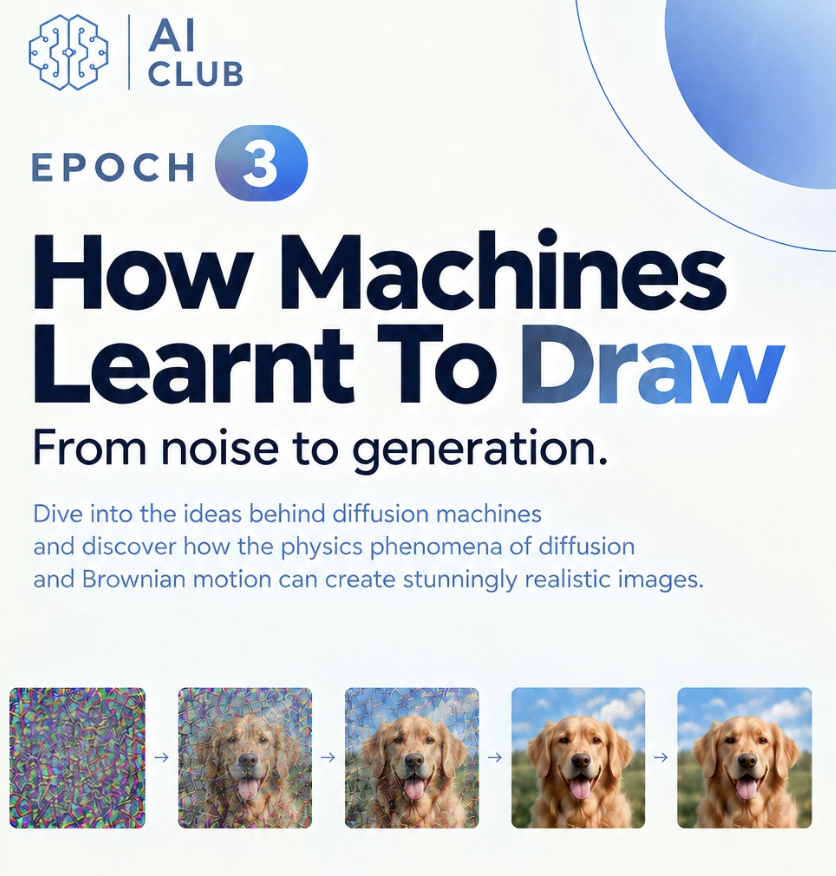
Epoch 3: How Machines Learnt to Draw

The Pre-Epoch built the prerequisites needed to understand diffusion models by revisiting neural networks and probability distributions, then covering CNNs, U-Nets, autoencoders, and Markov chains in depth.

On Day 1, participants developed an intuition for generative modelling and diffusion models through data and probability landscapes, forward noising, score-based learning and training, reverse diffusion, and DDPMs.

Day 2 focused on architecture and implementation, including modifications to U-Nets for diffusion, conditioning, samplers, latent diffusion, and implementing a diffusion model in code.
Resources
Date
Venue
CRC 102
An Introduction to Neural Networks — event artwork

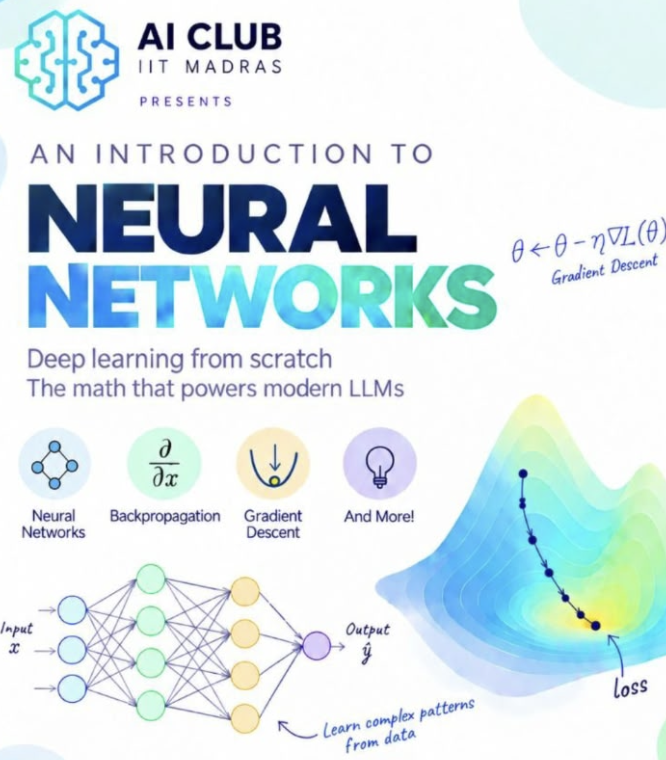
An Introduction to Neural Networks

A beginner-friendly introduction to neural networks that began with linear and polynomial regression to frame models as learned functions. The session then developed the core building blocks of a neural network like loss functions, weights, biases, and activation functions and showed how forward propagation produces predictions while gradient descent and backpropagation improve the model during training.

Resources
Date
Time
9:00 PM–11:00 PM
Venue
SSB 134
Prof Talks: Extreme 3D Reconstruction and Visualization — event artwork

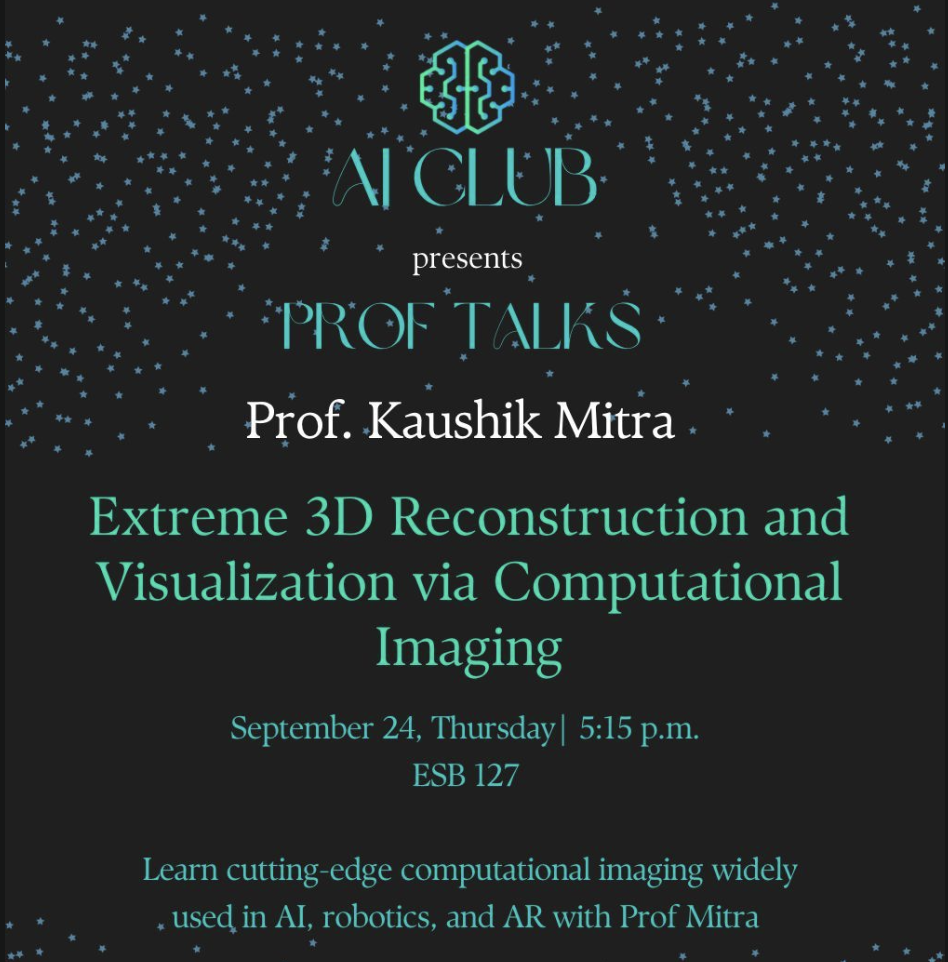
Prof Talks: Extreme 3D Reconstruction and Visualization

Prof. Kaushik Mitra explored how computational imaging can reconstruct and visualize 3D scenes beyond the limits of conventional cameras. The talk covered PRISM3D for severely motion-blurred scenes, PhotonSplat for extreme low-light reconstruction with single-photon sensors, and GANESH for lensless 3D novel-view synthesis, with applications spanning robotics, AR/VR, medical imaging, and wearable devices.

Resources
Date
Time
5:15 PM
Venue
ESB 106
AI Club Informals: Search Quest — event artwork

AI Club Informals: Search Quest

An informal session led by Adithya Rajagopalan on intelligent search algorithms. Starting with breadth-first search and Dijkstra’s algorithm, the session advanced to A*, AO*, optimization techniques, real-world applications, and hands-on demonstrations.

Resources
Date
Time
8:00 PM–10:00 PM
Venue
ESB 127
AI Club Informals: Gradient Flows — event artwork

AI Club Informals: Gradient Flows

Understanding training dynamics of modern deep learning models is quite challenging since they do not follow common assumptions on convexity, smoothness or large learning rates. Jayden, a student at IITM took a session giving an overview of gradient flows and central flows. The key idea was to find a differential equation that has the same behavior as gradient descent, I.e., the weights at timestep t are the same for both the continuous and discrete states. This helped give potential explanations for gradient descent self correcting despite a high learning rate relative to sharpness - i.e., how the model remains at the edge of stability without diverging. It also motivates why larger learning rates often end up in shallower minima.

Resources
Date
Time
8:00 PM–9:00 PM
Venue
ESB 127
Freshie Roadmap: Natural Language Processing — event artwork

Freshie Roadmap: Natural Language Processing

A freshie-friendly tour of how large language models process language, beginning with playful failure cases such as counting letters and writing lipograms. The session explored autoregressive next-token prediction, why models use tokens instead of whole words or individual characters, how embeddings and cosine similarity represent meaning, and why seemingly simple language and coding tasks can still trip models up.

Resources
Date
Time
8:30 PM
Venue
CRC 103
Software Summer School 2026: Artificial Intelligence — event artwork

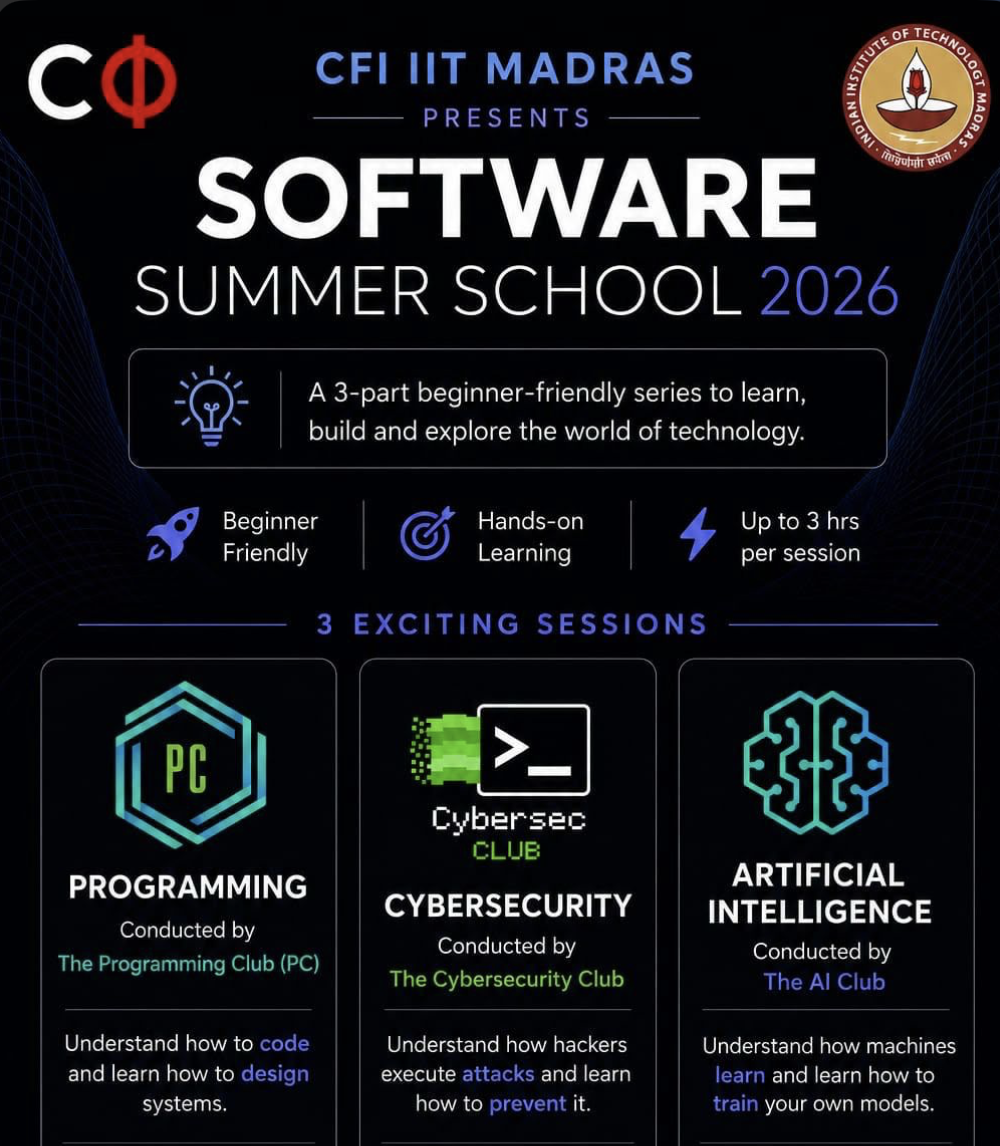
Software Summer School 2026: Artificial Intelligence

The AI Club’s session in CFI’s beginner-friendly Software Summer School introduced how machines learn across neural networks, computer vision, and natural language processing. Participants explored neural networks as function approximators, the universal approximation idea, computational graphs, backpropagation, and gradient descent, connecting the mathematics to training their own models.

Resources
Date
Time
5:00 PM
Knowledge Transfer Sessions — event artwork

Knowledge Transfer Sessions

A core learning initiative by the AI Club, aimed at strengthening the technical foundation of its members, the Knowledge Transfer Sessions (KTS) were a series of ten summer sessions covering core Machine Learning fundamentals, followed by an introduction to Deep Learning. The program emphasized collaboration, conceptual clarity, and hands-on learning across the ML–DL spectrum.

Resources
Date